The Semantic Notebook creates opportunities for serendipity by applying an empirical understanding of the term to prototype interactive systems that connect researchers to other researchers and resources, to discover things they ‘did not know they needed to know.’
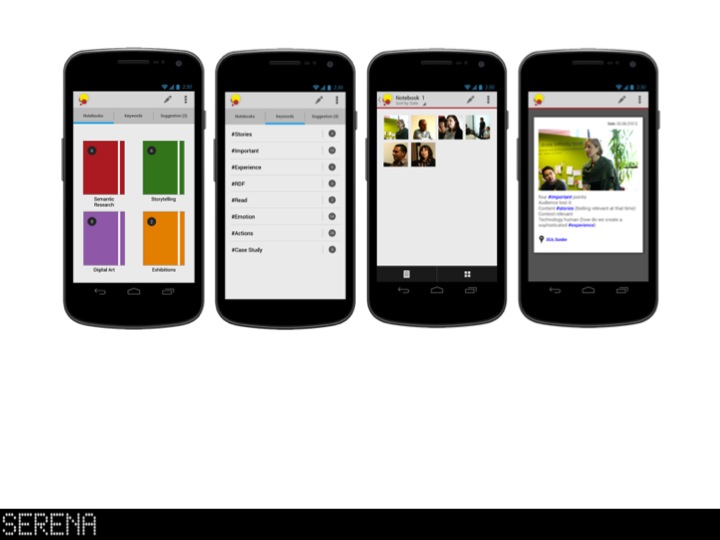
The semantic sketchbook is developed as a prototype Google Android smartphone app that uses the paradigm of a physical notebook (commonly used by creative professionals) to support digital note-taking in the form of text, image, drawing and sound.
It is a platform for conceptualising how notebooks and sketchbooks create a longitudinal approach to fermentation of ideas, conducive to supporting an emergent trend towards ‘slowing down’. This has been observed across all walks of life – characterised by the slow movements in cities (e.g. Cittaslow), food production, communities, and trade – in a bid to move away from materialism towards reflection, personal growth and satisfaction. Connected to these movements, the slowing down of mobile and situated digital experiences is a less developed but nevertheless growing undercurrent, relevant to creative practices, and cultural heritage and education sectors, amongst others.
Approach
The notebook concept and UI is underpinned by the development of an empirically-grounded process model of serendipity to identify key parts of the process where design has been applied to the design to aid users’ perceptions and realisation of serendipitous connections. A semantic reasoning system underpins the app to present potentially serendipitous suggestions to users as notifications, based on its understanding of the individual researcher user through their input of content, as well as to a user model through external data sources (e.g. a Twitter ID or a webpage with a list of publications).
Summary of Findings
We used the process model of serendipity to inform requirements for the design of tools to facilitate serendipity. However Design itself can play a role in creating a conducive environment for affect, which, in turn, can support elements in the model, process and perception of serendipity itself. Technologies developed with the foresight to use design as a way to gain positive, optimal, reflective experiences and increase opportunities for serendipity will provide an incubation space for connections between people and ideas in a real time, integrated, mobile setting, this may help us to lead more serendipitous lives.
Work will continue in keeping with our principles of user-centred design by observing how users actually use experience iterative prototypes of the semantic sketchbook. A study to evaluate the prototype app was conducted in Nov 2013 and will be reported in due course.